The Best WordPress Alternatives: Find the Perfect Platform for Your Website
WordPress powers over 43% of all websites on the internet. That’s a staggering number and for good reason. It’s flexible, community-backed, and battle-tested over more than two decades. But here’s a truth the WordPress faithful don’t always talk about: it isn’t the right tool for everyone.
Whether you’re a blogger frustrated by constant plugin updates, a business owner drowning in security patches, or a developer looking for a cleaner, more modern stack, the search for a WordPress alternative is completely valid. The good news? The website-building landscape has never been richer with options.
” A 2023 WP Engine survey found 34% of WordPress users cite security as their #1 concern. Sucuri’s annual report shows WordPress accounts for 96.2% of all infected CMS platforms they clean. “
Beyond security, there’s the learning curve. WordPress may look beginner-friendly on the surface, but the moment you want to customize beyond a theme, you’re wading into PHP, hooks, and shortcodes. And then there’s the cost — hosting, premium themes, and plugins can push your annual spend well past $500–$1,000.
Systeme.io
The All-in-One Powerhouse for Entrepreneurs.
If you’re building an online business not just a website, then Systeme.io might be the most compelling WordPress alternative you’ve never heard of. The platform has quietly grown to power over 500,000 entrepreneurs worldwide, and it’s easy to see why once you understand what’s under the hood.
The platform’s core pitch is simple but powerful: stop paying for five different tools when one can do it all. Where a typical WordPress setup requires separate plugins or services for email marketing, sales funnels, online courses, and affiliate management, Systeme.io bundles all of this natively into a single, unified dashboard.

What truly sets it apart is its pricing. Systeme.io offers a free forever plan, no credit card required, that includes core features most competitors lock behind paywalls. And unlike platforms that add transaction fees, Systeme.io charges zero transaction fees across all plans. Its support team boasts an average response time of under 24 hours, seven days a week.
| ✅ Best for
Online entrepreneurs, course creators, coaches, affiliate marketers, and anyone wanting an all-in-one business platform without the cost of stitching |
⚠️ Drawbacks
Design templates aren’t as visually stunning as Webflow or Squarespace. Blogging tools are more basic compared to WordPress’s mature publishing engine. |
Webflow
The Designer’s Dream.
Launched in 2013, Webflow has grown to host over 3.5 million websites and crossed a $4 billion valuation. Webflow gives designers pixel-perfect control over layout, animations, and interactions, all through a visual canvas while generating clean, semantic HTML, CSS, and JavaScript in the background.
For businesses and agencies, Webflow’s CMS is genuinely impressive. You can build custom content structures that rival WordPress’s custom post types, but with a far more intuitive interface.
| ✅ Best for
Designers, creative agencies, marketing teams, and businesses that want a polished, custom-looking site without hiring a developer. |
⚠️ Drawbacks
Pricing escalates quickly for larger teams. Learning curve is steeper than pure drag-and-drop builders. E-commerce features aren’t as robust as dedicated platforms. |
Ghost
Built for Serious Publishers.
Originally launched in 2013 as a Kickstarter project that raised over $300,000 in 29 days, Ghost was built to make publishing simple, fast, and focused. It has a built-in newsletter engine, native membership tools, and an editor so clean it practically encourages you to write.
” Ghost runs on Node.js rather than PHP, and independent benchmarks consistently show Ghost to be 5–10x faster than WordPress out of the box — a significant advantage when Google’s Core Web Vitals directly influence search rankings. “
| ✅ Best for
Independent journalists, newsletter creators, podcasters, and anyone building a subscription-based media business. |
⚠️ Drawbacks
Smaller ecosystem than WordPress. Requires more technical know-how to self-host. Limited plugin/integration marketplace. |
Squarespace
The Polished All-in-One
For users who want beauty and simplicity packaged together, Squarespace remains one of the strongest all-in-one solutions, with over 4 million paying subscribers. Every template is crafted with professional aesthetics in mind, and it bundles hosting, SSL, and domain management making your total cost of ownership predictable.
| ✅ Best for
Photographers, restaurants, small retailers, portfolio sites, and anyone who wants a gorgeous site without touching code. |
⚠️ Drawbacks
Customization has a ceiling. Once you outgrow built-in tools, options are limited. Closed platform — you don’t own the underlying infrastructure. |
Shopify
When E-Commerce Is the Priority
With over 1.75 million merchants in more than 175 countries, Shopify is the undisputed leader in hosted e-commerce. Its checkout experience is optimized for conversion, and a 2022 Littledata report found that Shopify stores have a median conversion rate of 1.4% vs. a cross-platform average of 1.1%.
| ✅ Best for
Online retailers of all sizes — from boutique shops to high-volume DTC brands. Anyone who wants best-in-class e-commerce without compromise. |
⚠️ Drawbacks
Singularly focused on commerce. Content-rich blogging and community features require workarounds. Transaction fees apply unless using Shopify Payments. |
Notion + Super.so
The Unconventional Underdog
Super.so lets you publish a Notion page as a full website in minutes. It’s barebones by traditional CMS standards, but remarkably effective for documentation sites, knowledge bases, personal portfolios, and simple blogs. For startups moving fast, this stack can take a new landing page from idea to live in under an hour.
| ✅ Best for
Startups, indie makers, technical documentation writers, and teams managing internal knowledge bases. |
⚠️ Drawbacks
Limited design flexibility. No advanced SEO tooling. Feature set doesn’t scale well for complex or high-traffic sites. |
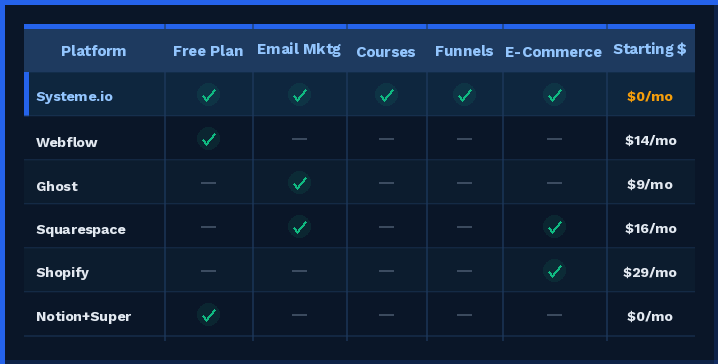
Platform Comparison at a Glance
Which Platform Is Right for You?
With so many strong options, the right question isn’t “What’s the best WordPress alternative?” It’s “What’s best for my specific needs?” Use this quick guide:
🚀 Building an online business (courses, funnels, email) → Systeme.io
✍️ Blogging or building a newsletter audience → Ghost
🎨 Designer or creative agency → Webflow
🛒 Running an e-commerce store → Shopify
📸 Portfolio, restaurant, or small business → Squarespace
⚡ Fast-moving startup or internal knowledge base → Notion + Super.so
The Bottom Line
WordPress is genuinely powerful, and for many use cases, it still wins. But “most popular” and “best for you” are not the same thing. The platforms above have each carved out niches where they don’t just compete with WordPress they surpass it.
The website building landscape is defined by specialization. Whether you’re optimizing for content velocity, e-commerce conversion, design quality, or raw performance, there’s a purpose-built tool waiting for you. The best time to explore your options is before frustration forces your hand.
Do your research, start a free trial or two, and make the move on your terms not WordPress’s.

I am the the Founder of SuccessGrid and I am so grateful you’re here to be part of this awesome community. I love connecting with people who have a passion for Entrepreneurship, Self Development & Achieving Success. I started this website with the intention of educating and inspiring people to always strive to Raise the Standards to Achieve Greatness.